
Why AI Still Cannot Fully Replace a Bookkeeper
Artificial intelligence is becoming part of everyday business life. Tools like ChatGPT, Claude, Gemini, and other AI programs can write emails, summarize documents, organize information, and explain complicated topics in seconds.
For small business owners, this naturally raises an important question:
Can AI handle bookkeeping too?
The honest answer is: AI can help, but it should not be trusted to manage your books by itself.
AI is a powerful tool, but bookkeeping is not just about putting transactions into categories. Good bookkeeping requires accuracy, context, review, and human judgment. That is where AI still falls short.
AI Can Sound Correct Even When It Is Wrong
One of the biggest risks with AI is that it can give very confident answers.
It may explain something in a professional way. It may create a clean report. It may suggest a category for a transaction that sounds reasonable.
But sounding correct is not the same as being correct.
In bookkeeping, small mistakes can create big problems. If a transaction is placed in the wrong category, your reports may not show the real condition of your business.
That can affect:
How much profit you think you made
How much tax you may owe
Whether your business looks healthy to a lender
How you make business decisions
How much money you believe you can safely take out of the business
AI may create an answer that looks polished, but the numbers underneath may still be wrong.
Bookkeeping Needs More Than a Guess
AI works by looking at patterns and predicting what answer is most likely. That is useful for many tasks, but bookkeeping needs more than a likely answer.
Bookkeeping needs the right answer.
For example, imagine your business receives a $20,000 deposit.
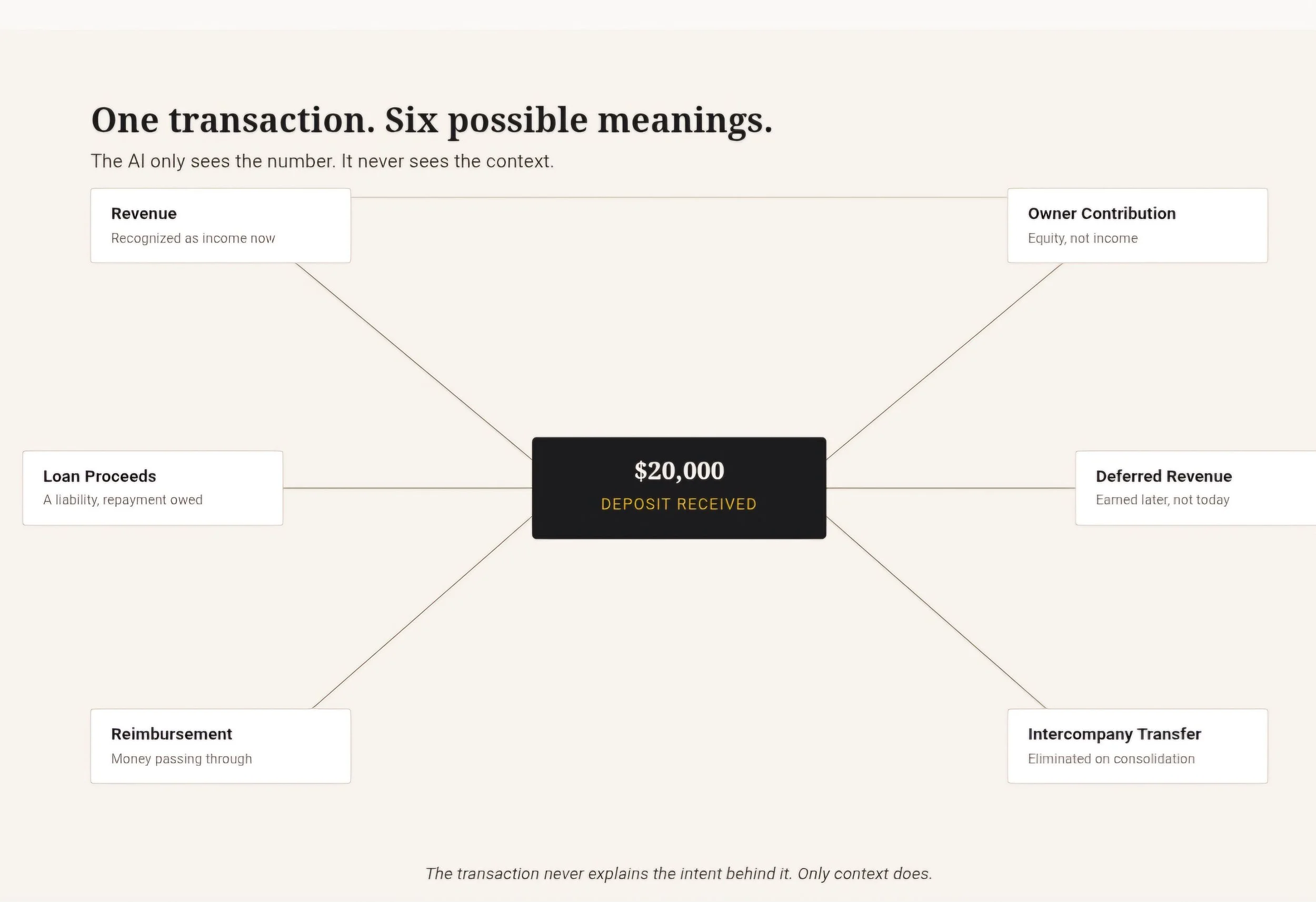
AI may try to categorize it as income. But that deposit could actually be:
A business loan
Money you personally put into the business
A customer prepayment
A refund
A transfer between accounts
Financing for equipment
Income from sales
The bank transaction alone does not tell the full story.
A bookkeeper would ask questions before deciding how to record it. Where did the money come from? Does it need to be paid back? Was there a customer invoice? Is there a loan agreement? Has this happened before?
AI may not know those details unless you provide them. And many small business owners do not know which details matter.
That is the danger.
AI Depends on the Information You Give It
AI can only work with the information it receives.
If you upload transactions and ask AI to “categorize these,” it may give you answers. But if important details are missing, the answers may be wrong.
For example, AI may not know:
A payment was actually an owner draw
A deposit was a loan, not sales income
A purchase was for inventory, not office supplies
A customer paid in advance for work that has not been completed yet
A transaction was a transfer between business accounts
A reimbursement should not be counted as regular income
A business owner may not mention these things because they may not realize they matter.
AI will usually still give an answer anyway.
That creates a false sense of security. The books may look organized, but they may not be accurate.
Missing Transactions Can Be a Serious Problem
Another issue is that AI may not always notice when something is missing.
Let’s say a business has sales every day, but one day of sales is missing from the records. AI may still create a monthly summary. It may still calculate income and expenses. It may still produce a nice-looking report.
But the report is incomplete.
That missing day could cause the business to:
Understate sales
Misread profit
Make poor spending decisions
Report incorrect sales tax
Misunderstand business growth
Give incorrect numbers to a lender or tax preparer
The report may look finished, but the business owner may be making decisions based on incomplete information.
This is why bookkeeping is not just about sorting transactions. It is also about checking that the records are complete and reasonable.
AI Does Not Truly Understand Your Business
Every business has its own story.
Two businesses may have the same type of transaction, but the correct bookkeeping treatment may be different.
A restaurant, contractor, online seller, consultant, and real estate investor may all spend money on similar things, but the way those transactions should be handled can depend on the business.
AI may not fully understand:
How your business earns money
How your customers pay you
Whether you carry inventory
Whether you use loans or financing
How your payroll works
Which expenses are personal and which are business
What your tax preparer expects to see
What happened in previous months
A human bookkeeper looks for patterns over time. They compare accounts. They ask questions. They notice when something does not make sense.
AI can assist with that process, but it should not replace it completely.
AI Can Repeat Bad Information
Another problem is that AI learns from a lot of information, and not all of that information is reliable.
There is plenty of bookkeeping advice online that is too general, outdated, or just wrong. Some advice may apply to one type of business but not another. Some advice may sound simple but miss important details.
AI may repeat information because it has seen similar examples before. But in bookkeeping, “similar” is not always good enough.
Business owners need accurate records, not generic answers.
Where AI Can Actually Help
This does not mean AI is useless in bookkeeping. AI can be very helpful when used the right way.
AI can help with:
Explaining bookkeeping terms in plain language
Creating checklists
Drafting client emails
Organizing notes
Summarizing reports
Finding questions to ask a bookkeeper or tax preparer
Creating reminders for bookkeeping tasks
Helping business owners understand basic financial reports
AI can save time and make bookkeeping easier to understand.
But AI should be used as a helper, not as the final decision-maker.
The Best Approach: AI Plus Human Review
The future of bookkeeping will likely include more automation. That can be a good thing.
Automation can help reduce repetitive work. It can help organize transactions faster. It can help identify patterns and speed up review.
But the best results still need human oversight.
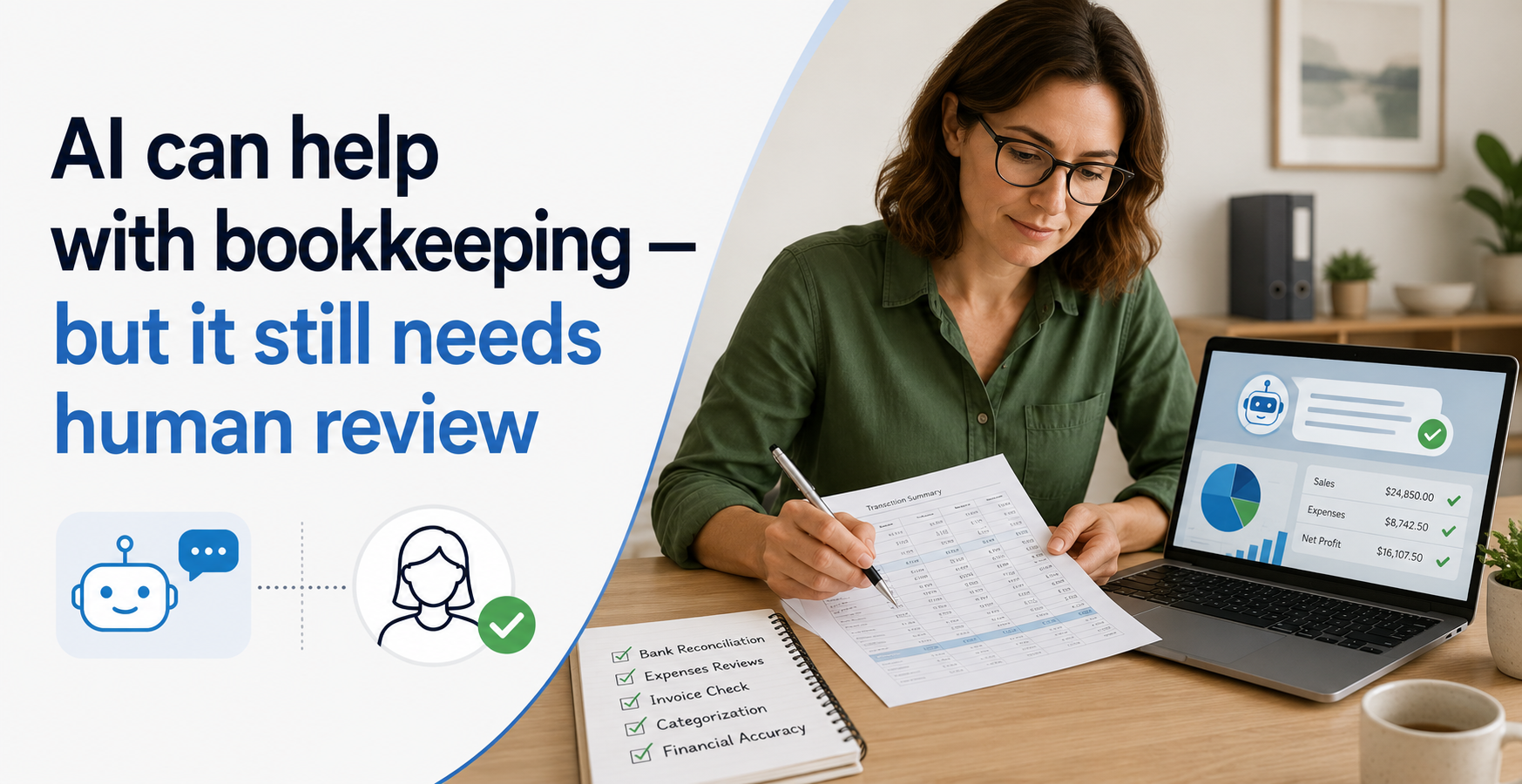
A bookkeeper can review the details, ask the right questions, and make sure the numbers make sense. A tax professional can help with tax rules and planning. AI can support the process, but it should not be the only thing protecting your financial records.
Final Thought
AI is a powerful tool, but your business finances are too important to leave completely on autopilot.
Clean books are not just about nice-looking reports. They are about knowing where your money is going, understanding your profit, preparing for taxes, and making better business decisions.
AI can help you move faster.
A knowledgeable bookkeeper helps make sure you are moving in the right direction.
If you are using AI or automation for your bookkeeping, that is okay. Just make sure someone is reviewing the work carefully before you rely on the numbers.
Your books do not need to be perfect every day, but they do need to be accurate enough to help you run your business with confidence.
