

Bookkeeper vs Accountant: What Small Business Owners Need to Know
Many small business owners use the words “bookkeeper” and “accountant” interchangeably, but they are not the same role.
Both can support your business finances, but they usually help in different ways. A bookkeeper helps keep your financial records accurate, organized, and up to date. An accountant or tax professional often uses those records for tax preparation, tax planning, compliance, and higher-level financial guidance.
For small business owners, understanding the difference can help you know what kind of support you need and when to ask for help.
At Simon Bookkeeping, we provide reliable bookkeeping services for startups, entrepreneurs, and growing small businesses in Bergen County, NJ, including Paramus, Hackensack, Ridgewood, and surrounding North Jersey areas. We also provide secure remote bookkeeping services to clients nationwide.
This guide explains the difference between a bookkeeper and an accountant, when your business may need each, and why clean bookkeeping makes accounting and tax preparation easier.
What Is a Bookkeeper?
A bookkeeper helps record, organize, and maintain your business financial transactions.
This includes tracking income, expenses, bank activity, credit card activity, payroll-related transactions, contractor payments, vendor records, and financial reports.
A bookkeeper helps make sure your books are accurate and current throughout the year, not just at tax time.
Common bookkeeping responsibilities include:
Categorizing income and expenses
Reconciling bank accounts
Reconciling credit cards
Reviewing transactions
Maintaining QuickBooks or accounting software
Cleaning up messy books
Tracking contractor payments
Supporting 1099 filing preparation
Reviewing payroll-related bookkeeping
Preparing financial reports
Keeping records organized and tax-ready
A bookkeeper helps create the financial foundation your business needs.
What Is an Accountant?
An accountant typically works with financial records at a higher level. Depending on their qualifications and services, an accountant may help with tax preparation, tax planning, compliance, financial analysis, business advisory, and filing requirements.
An accountant may use the records prepared by a bookkeeper to help with tax returns, financial strategy, or business planning.
Common accounting responsibilities may include:
Preparing tax returns
Providing tax planning guidance
Reviewing financial statements
Advising on business structure
Supporting compliance needs
Helping with tax-related questions
Reviewing financial performance
Advising on deductions and tax strategy
Supporting business planning
An accountant can provide valuable guidance, but they usually need clean bookkeeping records to do their job efficiently.
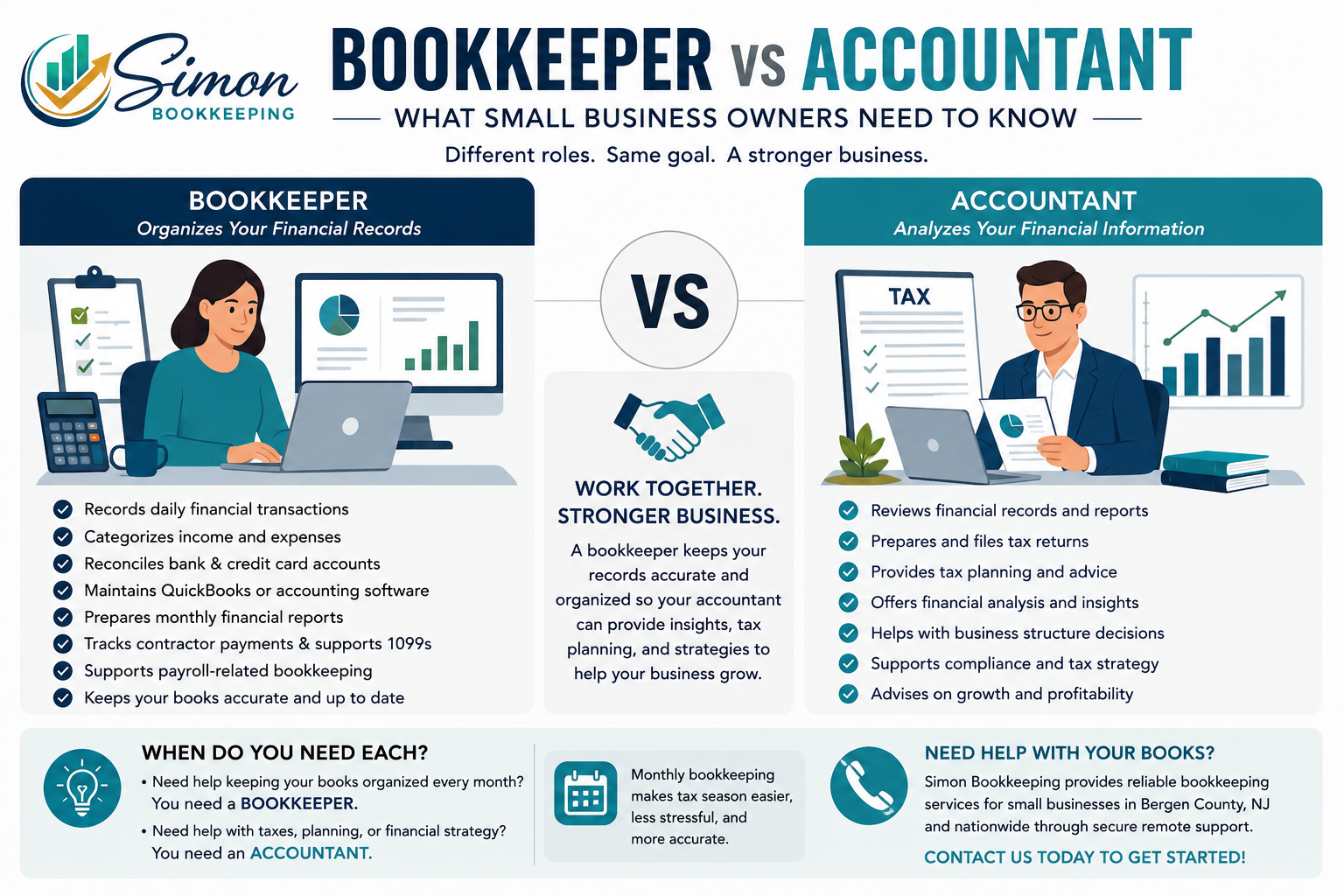
Bookkeeping vs Accounting: The Simple Difference
The simplest way to understand the difference is this:
A bookkeeper organizes the numbers. An accountant interprets, reviews, and uses those numbers for tax and advisory purposes.
Bookkeeping is usually more ongoing and operational. Accounting is often more analytical, tax-focused, or advisory.
Both are important, but they solve different problems.
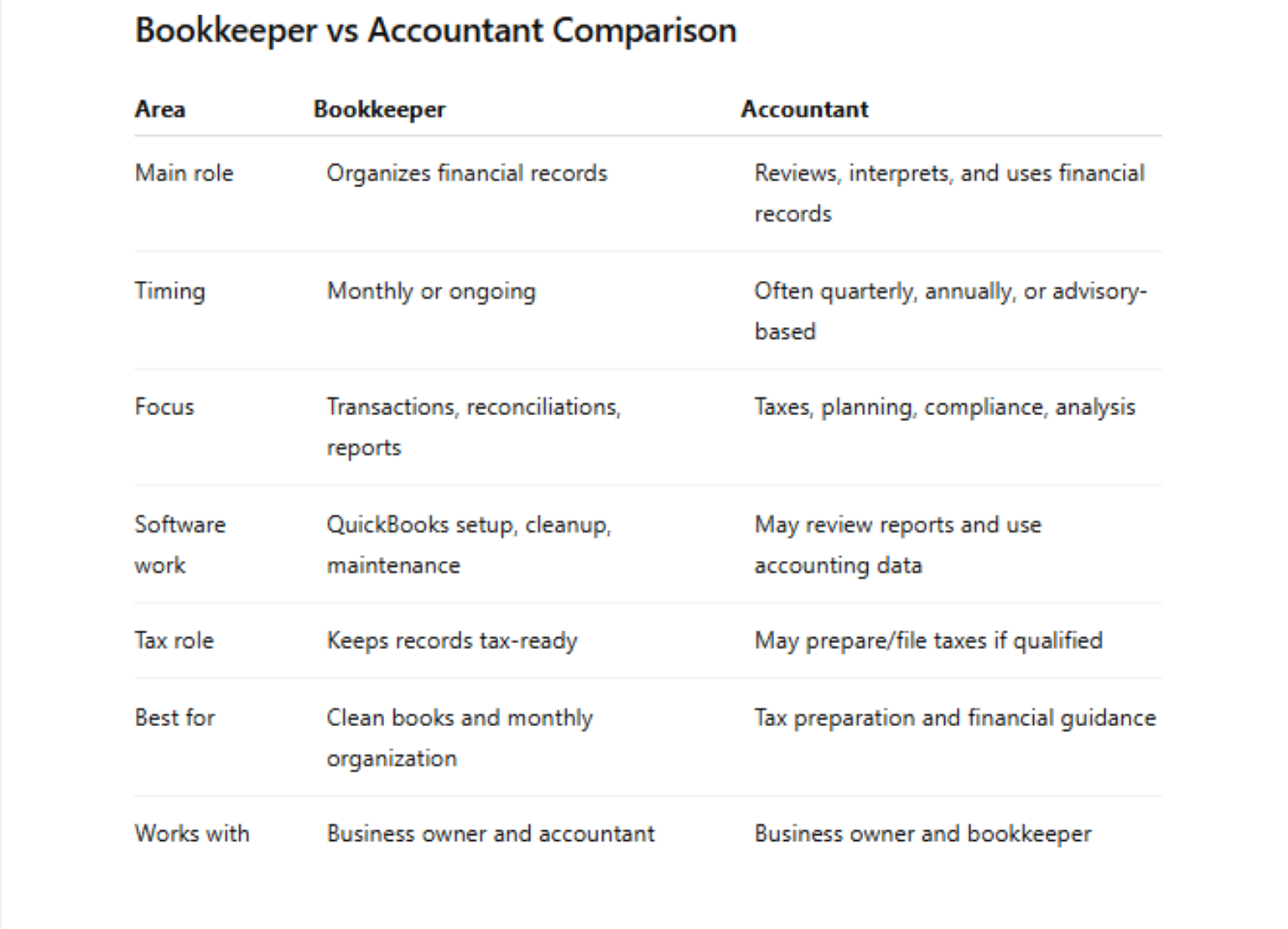
Bookkeeper vs Accountant Comparison
Why Small Businesses Often Need Both
A bookkeeper and an accountant work best together.
Your bookkeeper keeps the records organized throughout the year. Your accountant or tax professional can then use those records for tax preparation, tax planning, and advisory work.
When your books are clean, your accountant has better information to work with. When your books are messy, tax preparation may become slower, more stressful, and more expensive.
Clean bookkeeping can help reduce back-and-forth questions, missing information, unclear categories, and last-minute cleanup before deadlines.
When Do You Need a Bookkeeper?
You may need a bookkeeper if your business needs help staying organized month to month.
A bookkeeper is helpful when:
Your books are behind
QuickBooks feels confusing
Transactions are uncategorized
Bank accounts are not reconciled
You are mixing personal and business expenses
You need monthly financial reports
You work with contractors
You need help preparing for 1099 filing
You have payroll activity
Your accountant keeps asking for cleaner records
You are spending too much time on bookkeeping
You want better financial clarity
A bookkeeper helps prevent financial records from becoming messy in the first place.
When Do You Need an Accountant?
You may need an accountant or tax professional if you need tax filing, tax planning, compliance support, or higher-level financial guidance.
An accountant may be helpful when:
You need business tax preparation
You need tax planning advice
You are choosing a business structure
You have tax questions
You are preparing for major financial decisions
You need help understanding tax rules
You are applying for financing
You want higher-level financial analysis
You need compliance guidance
A bookkeeper can keep your records organized, but an accountant is usually the right professional for tax advice and filing support.
What Happens If You Only Hire an Accountant?
Some business owners wait until tax season and then send everything to an accountant.
This can work if your records are already clean. But if your books are messy, behind, or incomplete, your accountant may need to spend extra time cleaning up records before tax work can begin.
That can create problems such as:
Delayed tax preparation
More back-and-forth questions
Missing contractor information
Unclear expense categories
Unreconciled accounts
Messy QuickBooks reports
Higher stress near deadlines
Less visibility throughout the year
Monthly bookkeeping helps avoid the year-end scramble.
What Happens If You Only Hire a Bookkeeper?
A bookkeeper can help keep your books organized, but they may not replace the need for an accountant or tax professional.
You may still need an accountant for tax preparation, tax planning, compliance questions, and advisory guidance.
A strong setup often looks like this:
Bookkeeper: keeps records accurate and organized.
Accountant: handles tax filing, tax planning, and advisory work.
Business owner: uses the reports to make better decisions.
Together, this creates a stronger financial support system.
Why Clean Bookkeeping Helps Your Accountant
Clean bookkeeping makes your accountant’s job easier because your financial records are already organized.
This may include:
Reconciled bank accounts
Reconciled credit cards
Categorized expenses
Organized payroll records
Contractor payments tracked
1099 information prepared
Clean QuickBooks reports
Accurate profit and loss statements
Updated balance sheets
Supporting documents organized
When your accountant receives cleaner records, they can focus more on tax and advisory work instead of basic cleanup.
QuickBooks: Who Should Manage It?
QuickBooks can be managed by a bookkeeper, accountant, or business owner, but many small businesses benefit from having a bookkeeper maintain it regularly.
A bookkeeper can help with:
QuickBooks setup
QuickBooks cleanup
Bank feed review
Transaction categorization
Reconciliations
Chart of accounts organization
Vendor and customer records
Contractor payment tracking
Payroll-related bookkeeping
Monthly reports
An accountant may then review QuickBooks reports for tax preparation, tax planning, or business guidance.
Bookkeeping and Tax-Ready Records
Tax-ready bookkeeping means your records are organized before tax season arrives.
This includes keeping up with:
Income tracking
Expense categorization
Bank reconciliations
Credit card reconciliations
Payroll records
Contractor payments
1099 preparation
Financial reports
QuickBooks cleanup
Supporting documents
Tax-ready books help reduce stress and give your tax professional better information.
Common Mistakes Small Business Owners Make
Many business owners delay bookkeeping because they assume their accountant will handle everything at tax time.
Common mistakes include:
Waiting until year-end to organize books
Not reconciling accounts monthly
Leaving QuickBooks transactions uncategorized
Mixing personal and business expenses
Not tracking contractor payments
Forgetting to collect W-9 forms
Recording payroll incorrectly
Not reviewing financial reports
Assuming a bank balance shows profitability
Not asking for bookkeeping help early enough
These mistakes can create extra work later.
How to Decide Which Support You Need
Here is a simple way to decide:
If your financial records are messy, behind, or confusing, start with bookkeeping.
If your records are clean but you need tax filing, tax planning, or compliance guidance, speak with an accountant or tax professional.
If your business is growing, you may benefit from both.
Bookkeeping Services in Bergen County, NJ
Simon Bookkeeping provides bookkeeping services for small businesses in Bergen County, NJ, including Paramus, Hackensack, Ridgewood, and surrounding North Jersey communities.
We help startups, entrepreneurs, and growing businesses stay organized with monthly bookkeeping, QuickBooks setup, QuickBooks cleanup, payroll support, 1099 filing assistance, and financial reporting.
Whether your business is local to Bergen County or operates remotely, Simon Bookkeeping can help keep your books accurate, organized, and tax-ready.
Remote Bookkeeping Services Nationwide
Simon Bookkeeping also provides secure remote bookkeeping support to clients nationwide.
Remote bookkeeping makes it easier for business owners to work with a professional bookkeeper without needing frequent in-person meetings. With online accounting access, secure document sharing, and clear communication, bookkeeping can be handled efficiently from anywhere.
How Simon Bookkeeping Can Help
Simon Bookkeeping helps startups, entrepreneurs, and growing small businesses gain clarity and control over their finances.
Our services include:
Monthly bookkeeping
QuickBooks setup
QuickBooks cleanup
Payroll support
1099 filing assistance
Contractor payment tracking
Financial reporting
Remote bookkeeping services
Tax-ready recordkeeping
Our goal is to keep your records accurate, organized, and compliant so you can focus on growing your business with confidence.
Get Bookkeeping Support
If your books are behind, your QuickBooks file is confusing, or your accountant keeps asking for cleaner records, Simon Bookkeeping can help.
We provide reliable bookkeeping services for small businesses in Bergen County, NJ, North Jersey, and nationwide through secure remote support.
Contact Simon Bookkeeping today to get bookkeeping support and keep your records organized year-round.
Book Your Free Consultation
〰️
Book Your Free Consultation 〰️
Frequently Asked Questions
What is the difference between a bookkeeper and an accountant?
A bookkeeper organizes and maintains financial records. An accountant may use those records for tax preparation, tax planning, compliance, and financial guidance.
Does a small business need a bookkeeper or an accountant?
Many small businesses benefit from both. A bookkeeper keeps records accurate throughout the year, while an accountant may help with taxes and advisory work.
Can a bookkeeper prepare taxes?
A bookkeeper usually helps keep records tax-ready but does not replace a qualified tax professional unless they are separately qualified to prepare and file taxes.
Why does my accountant need clean books?
Your accountant needs clean books to prepare accurate tax filings, answer financial questions, and provide better guidance. Messy records can slow down the process.
Can Simon Bookkeeping work with my accountant?
Yes. Simon Bookkeeping can help keep your records organized so your accountant or tax professional has cleaner information to work with.
Can Simon Bookkeeping help clean up QuickBooks?
Yes. Simon Bookkeeping provides QuickBooks cleanup services for businesses with messy, outdated, or inaccurate QuickBooks records.
Do you offer bookkeeping outside Bergen County?
Yes. Simon Bookkeeping serves Bergen County and North Jersey businesses while also offering secure remote bookkeeping services nationwide.
